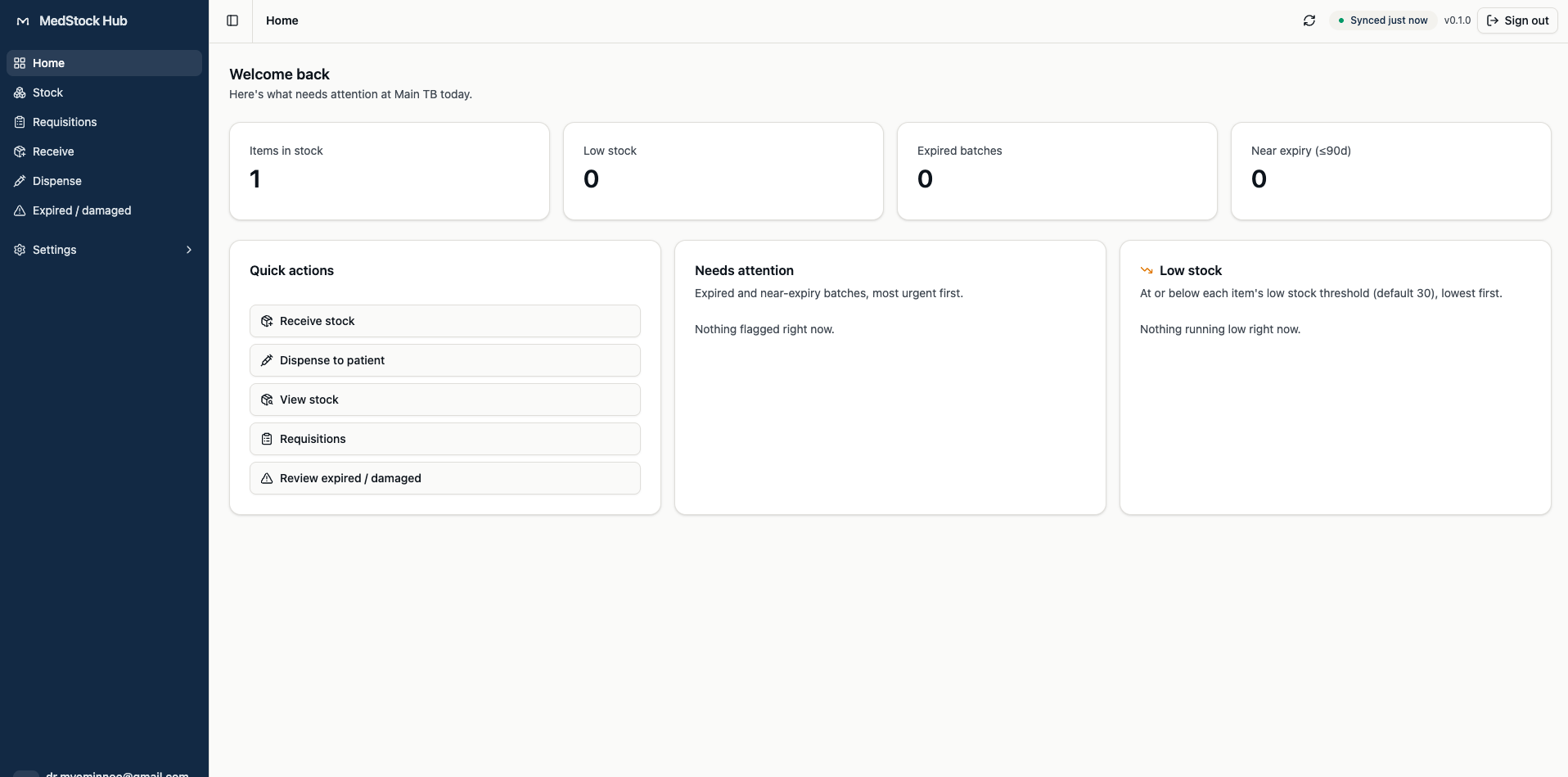
A medicine inventory tool has to match the conditions in which people use it. For local nonprofit medical-care teams supporting displaced people and refugees along the Thai–Myanmar border, that can mean working across a main store and smaller care locations, with limited equipment, variable connectivity, and little room for a complicated system.
MedStock Hub is an in-kind, early-stage product contribution designed around that reality. Its purpose is straightforward: help a team know what medicine is on hand, what is running low, what may expire soon, and what needs attention—without making reliable internet access a prerequisite for the day’s work.
The working flow covers receiving medicine, dispensing it, recording expired or damaged stock, reconciling a physical count, and managing requests between a main store and sub-stores. Batch-level tracking makes expiry information visible, while the dashboard gives staff a concise view of low stock, expiry signals, and the next useful action.
The important design decision is local-first operation. The app is an installable web app that keeps day-to-day work on the device, so a staff member can continue a core stock task during an outage. When connectivity becomes available, a separate sync path can update the central service. The interface makes that state visible rather than quietly assuming every device is current.
That is different from simply making a normal web application responsive. It affects the product from the start: controls need to be readable on a phone or tablet; actions need clear labels and recovery paths; data changes need to remain safe when a connection drops; and the system must not turn a short interruption into missing inventory records.
MedStock Hub is deliberately focused rather than a replacement for a national-scale supply-chain system. It is being shaped for a small organization and its practical store workflow, not for a large enterprise rollout. The partner organization is not named here, and the screenshots use non-sensitive demonstration data.
The product is not yet ready for a real-data pilot. The core offline workflow and online sync path are implemented, but stronger encryption and additional device-security controls are still required before it should hold live inventory data. Being clear about that boundary matters: a useful prototype is not the same thing as a production-ready health supply system.
The broader lesson is that custom software is most useful when its constraints are treated as design requirements. In this case, intermittent connectivity is not an edge case, and an overloaded interface is not a minor inconvenience. Starting with those realities has produced a simpler tool, with a clearer next step for the people who would use it.